


Thin coatings consisting of materials such as gold or platinum that were applied via sputter coating do not always have the “metallic appearance” we are familiar with in everyday life. Gold or platinum coatings with layer thicknesses below 15 to 20 nm do not have the “gold appearance” or “platinum appearance” that one would expect.
This is often interpreted by the operator of a sputter coater as if no or insufficient coating has been applied, while in fact the requested coating is present.
To address this common misunderstanding, LUXOR conducted a test in which layers of different thickness of gold and platinum were coated on a stub with carbon tape. These are the results:


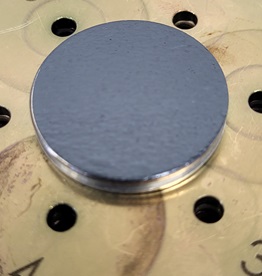


It is clear that the typical gold or platinum appearance only becomes visible for layers with a thickness above 20nm. Thinner layer thicknesses visually show only a somewhat reflective or grayish appearance. By elemental analysis in the electron microscope using EDS, it becomes clear that a gold or platinum layer is indeed present.
From a practical point of view it is important to note that, if you notice a clear gold or platinum layer on your coated sample, it is more than likely that the applied coating is a lot thicker than the classic 2 nm to 5 nm for platinum or 5 nm to 10 nm for gold required to prevent charging for most materials. In that case, you should adjust your coater’s parameters to coat thinner layers that leave the topography of the sample visible.
This sounds obvious, but when using manual coating systems, there is little or no control over the coating process parameters, often resulting in coatings that are too thick or not very homogeneous. In such cases, using the above images as a quick reference check can be very helpful in evaluating the quality and thickness of the applied coating.
Unsure about your coating results?
Our experts are here to assist with evaluating your coating quality and ensuring optimal results with your LUXOR coater.